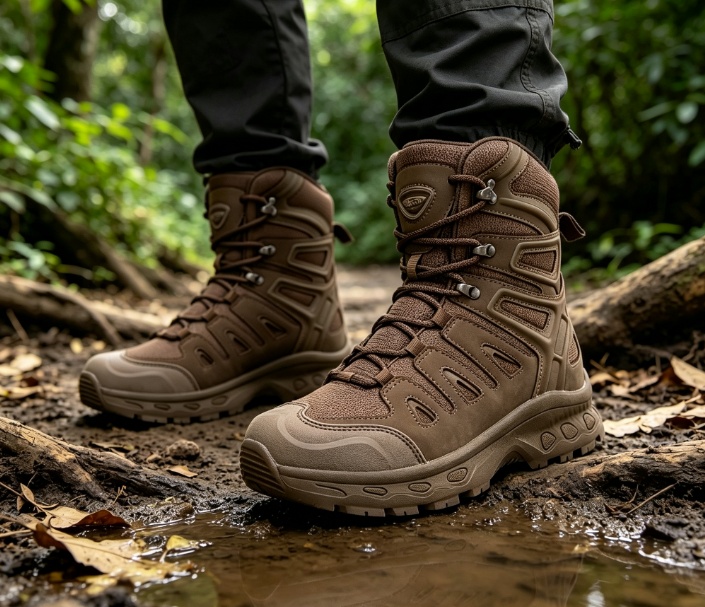
A product that looks convincing in a listing can still create returns, failed field use, or disputes when the delivered material and construction do not match the approved sample. For trade buyers, the useful distinction is not a vague idea of “real” gear; it is whether the equipment has verifiable specifications, consistent workmanship, and a traceable route from sample to shipment.
What “Real” Means in a Trade Purchase
“Real” should describe a product that can be checked against a defined requirement, not a logo, a camouflage pattern, or a dramatic product photo. A buyer needs to know the intended application, the materials promised, the construction points that matter, and the evidence available before a bulk order is released.
Appearance Is Only One Part of Quality
A camouflage uniform can look correct from a distance while the pocket attachment, seam density, fabric weight, or size grading is inconsistent. Likewise, a boot can have a tactical silhouette while its upper, outsole, lining, and fastening method are not suited to the requested operating conditions.
The same category label can cover several manufacturing levels, which is why a buyer should avoid judging quality from the product name alone. “Military uniform,” “tactical vest,” and “combat boot” describe families rather than one fixed specification, so the acceptance points must be concrete enough for different people to inspect consistently.
The purchase order should therefore convert visual expectations into observable checks. For a bdu kit, buyers can specify the fabric blend, size range, reinforced areas, closure type, pocket layout, and approved colorway rather than approving only a photograph.

Evidence Should Follow the Product Type
Different product groups fail in different ways, so the evidence request should follow the product. Uniforms need fabric and construction confirmation; footwear needs material and fit confirmation; load-carrying items need a clear view of attachment points, closures, and adjustment range.
Checks for Uniforms and Footwear
Jingming Trading’s stocked BDU-style uniform set uses a 65% polyester and 35% cotton fabric with a stated 215–220 g/m² weight, while its A533-309 boot combines EVA, rubber, mesh, PU, and polyester. Those details are useful only when the sample, order specification, and shipment all refer to the same product configuration.
| Product group | Check before approval | Useful evidence |
| Uniforms | Fabric blend, sizing, pocket and reinforcement layout | Labeled sample, measurement sheet, close-up images |
| Boots | Upper materials, outsole grip pattern, closure and ankle design | Paired sample, material confirmation, wear-point photos |
| Load-carrying gear | Panel construction, webbing, closures and adjustment points | Front/back images, accessory fit check, sample video |

A Sample Must Match the Production Decision
A sample is valuable when it becomes the reference for the bulk order, not when it is treated as a one-off display item. Record the sample date, color reference, materials, dimensions, and visible construction points, then use those details for the final inspection discussion.
This matters especially when comparing a fake military vest search result with a professional-use product. A quick-wear tactical vest can be evaluated through its stated 1000D nylon, modular layout, breathable mesh lining, hook-and-loop areas, and one-pull closure, but those features should not be confused with a claim of ballistic protection.
A Practical Pre-Shipment Checklist
- Match the order description to the approved sample and product photos.
- Confirm materials, size range, color, accessories, and packing before final inspection.
- Ask for clear images or video of the finished goods when visual construction details affect acceptance.
- Keep any application-specific requirement separate from general appearance preferences.
A short inspection record also improves the commercial handoff. It gives the buyer a precise reference for discussing a variation, gives the supplier a correction target, and helps the receiving team compare delivered cartons without relying on memory or a single product image.
Avoid Market-Level Assumptions
Broad search terms can make a category look more uniform than it is. The military camouflage uniform market contains products for different climates, duty roles, price points, and supply models, so a buyer should compare the relevant product specification rather than assuming that similar-looking gear has the same performance.
For a trade program, the strongest quality signal is repeatable documentation: an approved sample, a clear product description, and an inspection conversation tied to the ordered configuration. That approach also keeps customization discussions focused on what can actually be made and checked.
This method works for a private-label range, a catalog replenishment program, or a professional organization supply order. The goal is not to eliminate every variation; it is to identify which variations are acceptable, documented, and commercially manageable before they become a shipment problem.
Summary
The practical way to separate credible military-style gear from a risky imitation is to test the evidence behind it. Define the product’s application, verify the material and construction details on a sample, and make the same details part of the bulk-order acceptance process. Jingming Trading can help trade buyers align a uniform, boot, vest, or pack configuration with an approval-ready specification before production.
FAQ
How can a buyer check a military uniform before placing a bulk order?
Start with a labeled sample, measurement range, fabric composition, and close-up confirmation of the pockets, closures, and reinforced zones that matter to the intended use.
Does a tactical-looking vest automatically provide ballistic protection?
No. Appearance, modular panels, and load-carrying features are separate from protective performance. Buyers should request application-specific protection documentation when that requirement is part of the order.
What should be recorded from an approved sample?
Record the material description, color reference, size, visible construction details, accessories, packaging expectation, and any changes agreed before mass production.
Why is a product photo not enough for quality approval?
A photo rarely confirms fabric composition, internal reinforcement, size consistency, or the final configuration. It is useful evidence, but it should sit beside a clear written specification.
Can one quality checklist cover uniforms, boots, and tactical vests?
Use one common approval process, then add product-specific checks. Material, fit, closures, load points, and intended application vary enough that each group needs its own confirmation items.