
Are military boots good for hiking? Sometimes—but the answer depends on the trail, carried load, support needs, and how the sample feels after a controlled break-in. For wholesale buyers, are military boots good for hiking is best treated as a fit question, not a product-label promise. The related question, are army boots good for hiking, still needs the same route-specific check.
Trail conditions decide whether the build helps
Trail surface is the first filter because a boot that feels reassuring on loose ground can feel excessive on a paved path. National Park Service guidance recommends sturdy hiking boots with rubber soles and ankle support for dirt and gravel trails, while tennis shoes suit paved urban trails. That distinction gives a buyer a useful starting point: match outsole grip and upper structure to the surface before comparing styling or catalogue language.
For hiking in military boots, also consider moisture and heat. A breathable lining or mesh panel can make a high-top more tolerable in warm conditions, but breathability does not replace drainage or a dry-sock plan. On compact, wet, or uneven routes, ask whether the tread sheds mud and whether the collar holds the heel without rubbing.

Load and ankle support need a real-use check
Load changes the fit decision because a boot must stabilize the foot while a pack or work kit changes stride. NIST’s Army boot research frames footwear around the activity and performance needs, including durability, strength, shock attenuation, puncture resistance, and drainage. Those criteria explain why a model name alone cannot prove suitability; they do not mean a listed product has passed those tests.
Boot height can still guide a sample comparison. The Tiger Wolf catalogue example lists a mid-top tactical boot as a military boot for tactical training, outdoor hiking, and daily commuting. Treat that as a product scenario, not a universal definition. In a sample walk, add the intended load gradually and check heel lift, ankle pressure, flex at the forefoot, and whether the collar stays clear of the Achilles.
The practical comparison is therefore tactical vs hiking boots: which construction keeps the wearer stable on the stated route without creating unnecessary fatigue? Buyers comparing the best tactical boots for hiking should also consider comfortable combat boots for walking as a use-case question, not a universal ranking. A taller boot may feel protective, while a lighter hiking build may reduce heat and flex effort. The useful choice depends on the use case and the wearer’s tolerance.
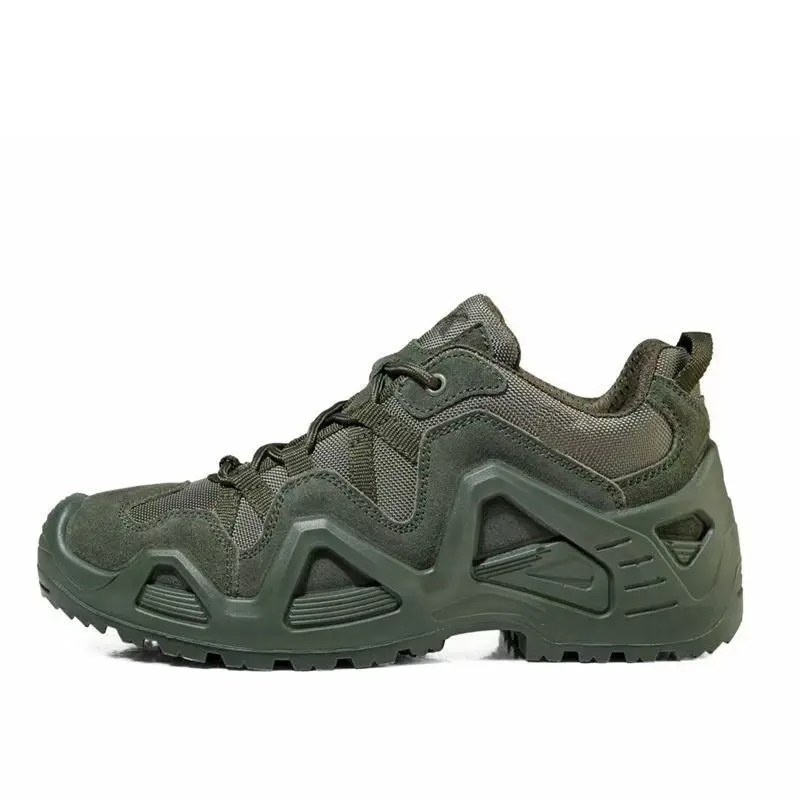
Materials, cushioning, and break-in show up in the sample
Material and listed weight help explain why two military boots can feel different, but they are not a comfort ranking. The 07 Combat Boots page lists a high-top tactical boot in Rubber, Cowhide, and Oxford cloth, sizes 39–46, with anti-slip, wear-resistant, breathable, and tear-resistant features and a listed weight of 0.8 kg per pair. The M16 page lists a similar high-top construction and feature set at 0.75 kg per pair.
The A533 pages list EVA, Rubber, Mesh, PU, and Polyester, sizes 39–46, with anti-slip, wear-resistant, breathable, waterproof, and tear-resistant features and a listed weight of 1.2 kg per pair. A533-1907 separately lists a side zipper; keep that detail with that model and do not transfer it to A533-309. These fields are useful for a catalogue comparison, yet a short walk is still needed to reveal pressure points, heel movement, flex, and heat.
A responsible break-in plan starts with a brief indoor fit check, then a short level walk, then the intended surface and load. Stop if the heel slips, the toe box compresses, or the collar creates a hot spot. There is no single break-in time that can be promised from the product pages, so buyers should record the wearer, socks, route, load, and observed comfort for each sample.
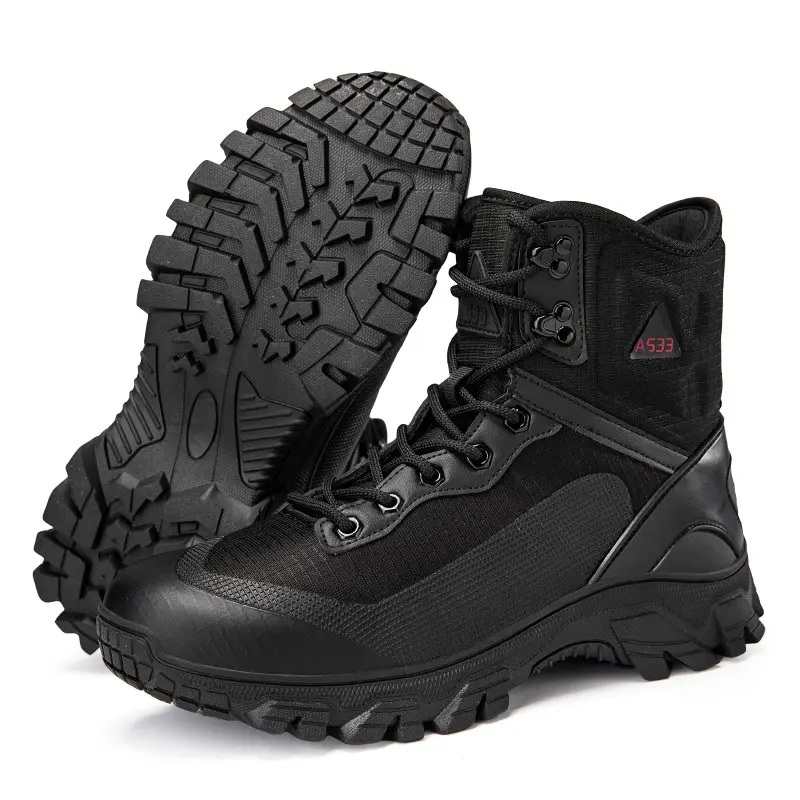
A model-level comparison keeps wholesale samples honest
A wholesale comparison is clearer when the exact model fields a customer will later see stay together. Keeping materials, size range, listed features, and listed weight in one view prevents a sample decision from combining details from different pages. For a broader hiking boots vs military boots discussion, use the same discipline: compare the intended route and use case before treating one category as automatically better.
| Model | Build | Materials | Listed weight | Buyer check |
| 07 Combat Boots | High-top tactical | Rubber; Cowhide; Oxford cloth | 0.8 kg/pair | Grip, collar, heat |
| A533-1907 | A533 tactical boot | EVA; Rubber; Mesh; PU; Polyester | 1.2 kg/pair | Waterproof claim; side zipper; pressure points |
| A533-309 | A533 tactical boot | EVA; Rubber; Mesh; PU; Polyester | 1.2 kg/pair | Keep model details separate; test flex |
| M16 Boots | High-top tactical | Rubber; Cowhide; Oxford cloth | 0.75 kg/pair | Compare heel hold and forefoot flex |
Route fit is the decision buyers can explain
Military boots can work for hiking when the route, load, and construction agree. Dirt and gravel trails justify closer attention to rubber traction and ankle support; paved paths may reward a lighter, more flexible option. The most defensible assortment decision is the one backed by an exact model, a stated use scenario, and a sample walk that records fit under real conditions.
For a wholesale line, keep the product page fields and the wearer feedback together. Confirm the model, materials, size run, listed weight, and feature set before comparing samples, then confirm commercial details separately with the supplier. This approach answers the hiking question without turning a catalogue feature into an unsupported performance guarantee.
Jingming Trading can help buyers compare the exact boot model against the route and use case they serve. Share the intended terrain, climate, load, and size range when you request a sample review so the conversation stays tied to a testable fit decision.
FAQ
Are military boots good for hiking on paved trails?
They can be, but a lighter and more flexible shoe may be more comfortable on long paved sections. The route surface and heat tolerance should guide the choice.
Is a high-top always better for carrying a load?
No. Height is one comparison point. Test heel hold, ankle pressure, flex, and comfort with the intended load instead of assuming a fixed support level.
How long do military boots take to break in?
There is no supported universal time. Use short, progressive walks and stop when rubbing, heel lift, or pressure appears.
Are A533 boots suitable for hiking?
A533 pages list materials, features, sizes 39–46, and a listed 1.2 kg per-pair weight. Review the exact model and test the sample on the intended route.
What should a wholesaler record during a sample test?
Record the exact model, route surface, load, socks, weather, pressure points, heel movement, flex, heat, and any change after the walk.


