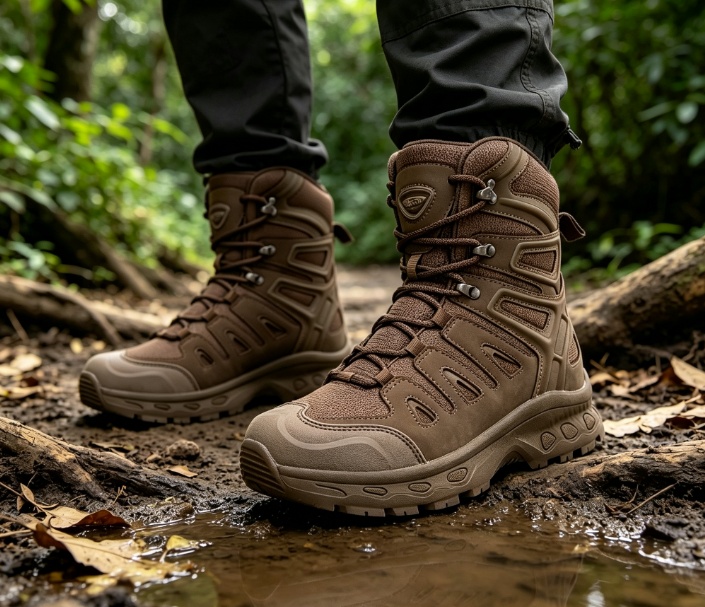

Purpose and Design Intent of Hiking Boots vs Military Boots
Functional Objectives of Hiking Boots
Hiking boots are made for one main aim: ease and backing during long walks on rough ground. Their build puts a lot of focus on padding, ankle support, and air flow to fit outdoor settings. Most hiking boots have soft collars, body-fitting insoles, and light midsoles. These often come from EVA. Such parts cut down shock to joints and lower tiredness.
The light build matters a lot for people who trek far. Cutting weight keeps energy up. This is key when going up or down sharp paths. Airy mesh parts are usually added to the top. They let air move around. So, they stop too much heat and extra wetness from building up.
Tactical Purpose Behind Military Boots
On the other hand, military boots are built for fight readiness and planned actions. They put first strong lasting power, safety strengthening, and weather toughness. Soldiers, police, or guards use them. These boots must handle hard strain and meet high-performance requirements for occupational safety.
Material Composition and Durability Comparison
Common Materials Used in Hiking Boots
Hiking boots often use stuff that mixes ease with fair lasting power. Soft leather gives a bend. Mesh parts help air pass through. EVA midsoles show up a lot. They give a great shock catch and light feel. These picks make hiking boots good for fun use. But they shorten life in tough or risky spots.

Military Boot Construction Materials
Military boots pick tougher stuff meant to hold up under pressure. Boots like the Storm Boots and Tiger Wolf Boots use a mix of cowhide, Oxford cloth, and rubber bottoms. These are known for rub resistance and power.
In 2025, modern military construction also incorporates ESG-focused updates. Many professional models now utilize LWG-certified (Leather Working Group) cowhide to ensure sustainable sourcing and reduced environmental impact. Parts like strong toe ends and twice-sewn edges make sure they last long in hard lands and weather. These build choices make military boots the best law enforcement boots to pick. That is when field trust over time counts most.
Traction and Outsole Performance Differences
Outsole Design in Hiking Footwear
Hiking boots are set up for path hold. Their bump patterns are deep and go many ways. This boosts grip on soil tracks, stones, and wet hills. The rubber mixes try to match hold and soft step. Bottoms often have bend lines. These keep a normal walk feel over different spots. So, they add more to ease on long walks.
Tactical Boot Outsoles for Combat Readiness
Military boots show bolder step marks made for city spots and off-path areas. For example, the M16 Boots have no-slide rubber bottoms with a hold for any land. These fit military outdoor activities. The soles are usually oil-proof, slide-proof, and stab-proof, often tested against ISO 20347 standards for occupational footwear.
These parts give the best foot lead. It works on town roads or sand lands. This is a main split in tactical boot vs hiking boot styles. Professional tactical soles are engineered to handle chemical spills and sharp debris that would compromise a standard hiking tread.
Weight and Mobility Considerations
Lightweight Advantage of Hiking Boots
Hiking boots stress cutting weight to boost quick moves on long trips. Lighter shoes lower muscle wear and raise walking speed. Hikers do not face fight risks often. So, this swap works in fun cases. A usual pair of hiking boots weighs 1 to 1.2 kg. This depends on stuff picks and warm layers.
Balancing Protection with Agility in Military Boots
Military boots weigh more by nature. That comes from strong tops, safety layers, and rough bottoms. But new styles try to match this weight with better movement ease. The A533-309 boots weigh about 1.2 kg per pair. Yet they have EVA midsoles that absorb shock without being too large.
Running combat boots show this match. They give planned power with lighter shapes that help with fast steps. Such mixed styles grow in like at any tactical boot store. Pros who need both move and safety pick them. When comparing hiking boots vs military boots, the latter provides a superior strength-to-weight ratio for high-intensity duty.

Comfort Features: Cushioning, Fit, and Break-In Time
Comfort Priorities in Hiking Footwear Design
Ease tops the list in hiking boot build. Most hiking boots add soft collars, padded insoles, and body-fit shapes. These make a tight but free fit. They use milder stuff like soft leather or mesh. So, the wear-in time is short. This makes them easy for new or light hikers.
Comfort Trade-Offs in Military Boot Engineering
Military boots give strong foot support with built-in arch support and thick midsoles. But they may need longer wear-in times. That is from their hard build. Boots like the 07 Combat Boots have tall-top ankle backing with air-flow linings. These cause unease during long wear.
At first, they feel stiffer than hiking ones. Still, these boots are made for holding in bad spots. They give ease through toughness, not softness. Modern tactical designs now include moisture-wicking antimicrobial linings to improve long-term foot health.
Environmental Adaptability: Weather Resistance and Breathability
Weather Protection Capabilities of Hiking Boots
Many hiking boots add waterproof sheets like Gore-Tex or their own liners. These blocks get wet while letting steam out. In warm styles, mesh parts help air flow. They cut sweat build. But very cold or hot sand can test the usual hiking boot builds.
All-Terrain Readiness of Military Footwear
Military boots often show a two-weather fit. Waterproofing with fast-dry linings lets them work in many places. For instance, the Flying Boots have air-flow linings that keep feet dry. They also give a mid-top bend for sand or city ground. Some types add warm layers for ice-cold spots or use sunblock for hot sand. This makes them fit all seasons.
Use Case Scenarios: When to Choose Each Type of Boot
Ideal Situations for Using Hiking Boots
Hiking boots fit best for fun actions like:
-
Trail walking
-
Backpacking trips
-
Camping
-
Day hikes in varying terrain
Tactical Situations Favoring Military Footwear
Military shoes are the top pick in cases where:
-
Lasting against rough ground is key
-
You need strong safety from sharp things (ASTM F2413 rated)
-
Police or guard jobs are in play
-
The weather needs tough waterproofing
Summary of Key Differences Between Tactical Boot vs Hiking Boot Designs
| Feature | Hiking Boots | Military/Tactical Boots |
| Weight & Agility | Lighter; ideal for endurance | Heavier; designed for protection; some agile variants (e.g., running combat boots) |
| Terrain Adaptability | Lug soles optimized for natural trails | Aggressive tread; suitable for urban/mixed terrain; oil and slip resistant |
| Comfort & Break-In | Soft materials; short break-in | Rigid; longer break-in; long-term support; orthotic-friendly |
| Durability & Protection | Moderate durability; less protective | High durability; reinforced construction; often LWG-certified |
Military boots from Guangzhou Jingming Trading Co., Ltd. cover types like the 07 Combat Boots and M16 Boots. Both have tall-top styles for better ankle safety. They include no-slide rubber bottoms for holding on any ground. Plus, they have air-flow linings to keep feet from getting wet. These boots fit high-energy planned use. That comes from their light fake-fibre tops and rip-proof build. Types like the A533-309 also have side zippers for fast putting on. This is vital in spots where quick moves are needed. It matches well with the role of running combat boots.
These mix planned strength and move-focused shoes, making them a preferred choice for agile tactical maneuvers.
FAQs
Are running combat boots better than standard tactical boots for mobility?
Yes, running combat boots provide a hybrid solution by offering lighter weight with tactical-grade protection. They are ideal for scenarios requiring agility without compromising safety.
Can hiking boots be used for work in security or law enforcement?
Not recommended. Hiking boots lack the reinforced toe caps, abrasion resistance, and multi-surface traction found in the best law enforcement boots.
How long do military boots typically last compared to hiking boots?
Military boots generally last longer due to their rugged materials, like cowhide and reinforced outsoles. Hiking boots may degrade faster under heavy-duty use.
Do tactical boot stores offer waterproof options?
Yes. Many models, such as the A533-309 or VW Hiking Boots, come with waterproof fabric designs at a specialized tactical boot store suitable for wet environments.
Which boot type has better ankle support?
Military boots usually provide superior ankle support due to high-top designs reinforced with padding. This is crucial during rapid tactical maneuvers or carrying heavy gear in a tactical boot vs a hiking boot comparison.