
Modern defense logistics has shifted into a highly structured and time-sensitive ecosystem where military classes of supply directly influence how fast and accurately resources move across operational zones. In this system, military supply is no longer just transportation or storage; it becomes a coordinated framework that ensures readiness under pressure. Jingming Trading, a Guangzhou-based integrated manufacturer, operates within this logic by supporting large-scale supplies for military clients through OEM and ODM production systems. The company’s factory, covering more than 6,800 square meters with over 200 production workers and a warehouse exceeding 5,300 square meters, demonstrates how industrial capacity connects directly to global defense supply expectations, especially across Middle Eastern and African procurement channels .
What do military classes of supply mean in military supply systems
Military classes of supply are structured groupings that define how materials are categorized, stored, and distributed within defense logistics. In practical military supply operations, this classification determines how quickly a unit can access necessary equipment, how inventory is prioritized, and how procurement is scheduled.
Within large-scale systems such as those managed by Jingming Trading, this classification logic is mirrored in product segmentation. Tactical uniforms, military boots, backpacks, and field accessories are treated as distinct operational categories rather than generic inventory. This approach reflects how supplies for military operations must remain organized under strict logistical logic to prevent delays during deployment cycles.
Military classes of supply also help standardize communication between manufacturers, procurement officers, and field operators. When a supply request is issued, the classification ensures that every stakeholder understands whether the request refers to clothing systems, mobility gear, or support equipment.
Why military classes of supply matter in modern military supply chains
The importance of military classes of supply becomes clearer when logistics complexity increases. Modern military supply chains often operate across borders, climates, and infrastructure gaps. Without structured classification, procurement systems risk delays, duplication, or a mismatch in operational needs.
For Jingming Trading, classification is reflected in how production lines are organized. Uniform sets, tactical boots, and backpacks are manufactured in parallel but managed under different supply categories. This ensures that supplies for military clients are delivered according to mission-specific requirements rather than general stock availability.
The company’s long-term cooperation with overseas government and military clients demonstrates how structured classification supports stable delivery cycles. In environments where rapid replenishment is required, military classes of supply reduce uncertainty and improve coordination between production and logistics teams.

How Jingming Trading integrates military supply requirements into production systems
Jingming Trading operates as a modern industrial supplier that aligns manufacturing capacity with global military supply expectations. According to internal company structure data, the organization manages large-scale OEM/ODM production, ensuring stable output across multiple product categories including tactical clothing, boots, and field equipment .
This industrial setup directly supports supplies for military procurement programs that require consistency rather than isolated production runs. The company’s ability to maintain 100,000+ ready inventory items and nearly 20 million sets of annual capacity enables a predictable supply flow across different military classes of supply.
The production logic can be understood more clearly through a structured comparison of key product categories:
| Supply Category | Product Type | Material Composition | Operational Function |
| Clothing Systems | Tactical uniforms (BDU, G9, bomber jacket) | 65% polyester / 35% cotton | Field durability and environmental adaptability |
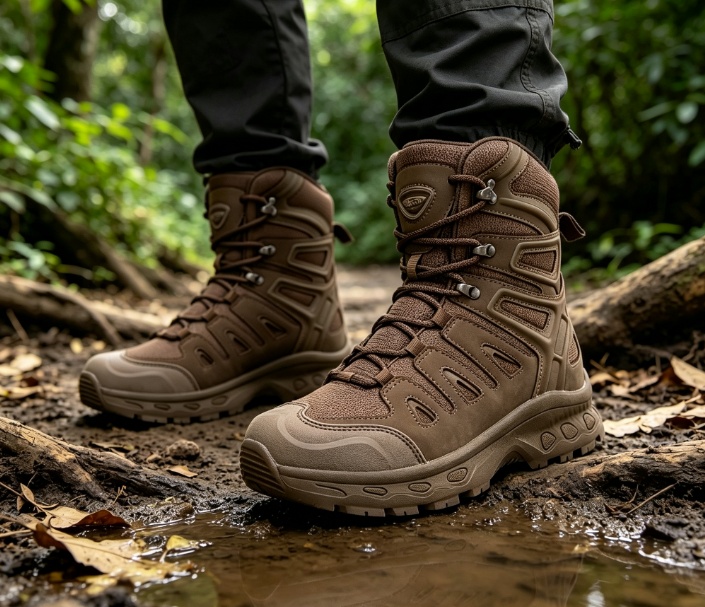
| Mobility Equipment | Military boots (M16, A533, Tiger Wolf) | Leather, rubber, EVA, mesh | Terrain stability and long-distance movement |
| Load Carrying Systems | Tactical backpacks (45L, 807 series) | 800D Oxford cloth | Storage, transport efficiency, load balance |
| Field Accesso
ries |
Tactical belts, gloves, face masks | Nylon, microfiber, cotton blends | Operational support and field usability |
This structure reflects how military classes of supply translate directly into manufacturing logic, ensuring that military supply systems remain synchronized with real operational needs.
How product engineering aligns with military classes of supply
In real-world procurement, military classes of supply are not abstract definitions but practical production guidelines. For example,backpack systems such as the 45L and 807 Mountaineering Backpack are engineered with 800D Oxford fabric, waterproof coatings, and modular compartments. These specifications align with logistical supply expectations where equipment must remain functional under variable environmental conditions.
Even smaller components like tactical gloves and belts are treated as part of integrated military classes of supply, ensuring that every layer of equipment contributes to overall operational efficiency rather than functioning as isolated products.
What challenges affect military supply chain efficiency today
Despite structured classification systems, modern military supply networks still face operational challenges. One of the most significant issues is synchronization between production speed and demand fluctuation. When military classes of supply are not aligned with real-time demand, delays can occur in critical supply categories such as mobility gear or field accessories.
Another challenge lies in cross-border logistics coordination. Supplies for military operations often require export compliance, customs clearance, and multi-stage transportation planning. Without standardized classification, these processes become slower and more error-prone.
Jingming Trading addresses these challenges by maintaining integrated production and warehousing systems. This reduces dependency on fragmented suppliers and ensures that military supply chains remain stable even under high-demand conditions.

Conclusion
Military classes of supply remain a foundational structure in modern logistics, shaping how military supply systems operate across procurement, manufacturing, and deployment. Companies like Jingming Trading demonstrate how industrial capability and structured classification work together to support global supplies for military operations. By aligning production systems with clear logistical categories, supply chains become more predictable, scalable, and responsive to real-world operational needs.
FAQ
What makes Jingming Trading suitable for supplies for military procurement programs?
Jingming Trading maintains large-scale OEM/ODM production capacity, stable inventory levels, and multi-category manufacturing systems, allowing consistent supplies for military operations across different regions.
How does Jingming Trading ensure quality in military supply production?
Quality control is maintained through pre-production sampling, final inspection before shipment, and optional video verification processes, ensuring that military supply standards remain consistent across batches .
What types of products are included in military classes of supply at Jingming Trading?
The system includes tactical uniforms, military boots, backpacks, belts, gloves, and field accessories, all structured to support different segments of military supply operations.
How does Jingming Trading handle large-scale military supply orders?
With over 100,000+ inventory stock and large warehouse capacity, Jingming Trading can process bulk orders efficiently while maintaining alignment with military classes of supply requirements.