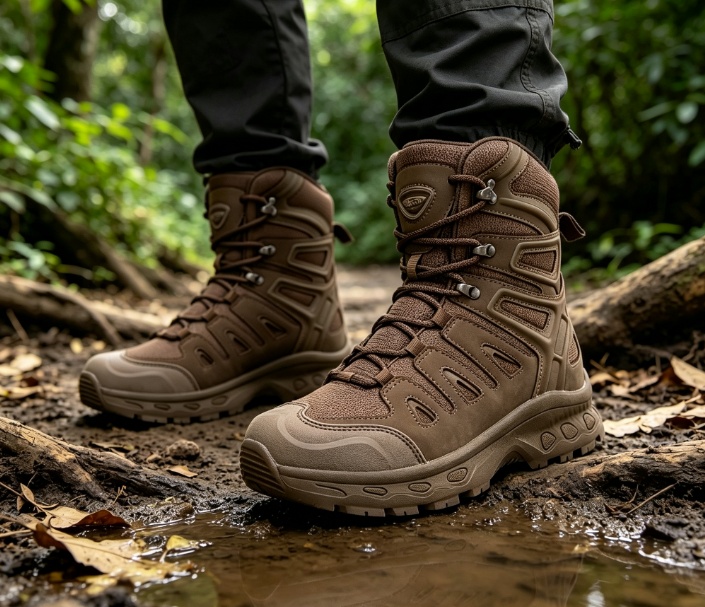

A combat boot can look rugged and still fail a distributor’s return-rate test. Buyers need a way to compare grip, weight, upper materials, fit, and supply evidence before committing to a size run. This guide turns those questions into a purchasing brief, using Jingming Trading’s tactical boot range and the A533-309 as a benchmark.
Field Reality Changes the Brief
The right boot depends on the work pattern, not the word “tactical.” A security contractor may need long standing, repeated vehicle entry, and dependable traction, while an outdoor retailer may prioritize comfort across mixed trails. OSHA’s foot-protection rule also reminds employers to match protective footwear to hazards; that is a useful discipline for every commercial brief.
A buyer comparing military boots vs hiking boots should define the dominant surface, wet-weather exposure, daily wear time, and replacement cycle. Short-training boots may be too heavy for retail wear, while trail shoes may lack ankle support or abrasion resistance.
Mission fit matters before model selection
The most useful specification starts with the user’s movement pattern. Ask whether the wearer walks, runs, climbs ladders, stands at a checkpoint, or moves between pavement and loose ground. Those answers determine whether to emphasize a high-top collar, aggressive outsole, breathable lining, water resistance, or a lighter midsole.
- Surface: pavement, gravel, mud, wet concrete, or mixed terrain.
- Duty cycle: short training blocks, shift work, or daily consumer wear.
- Fit range: required sizes, width expectations, and sock thickness.
- Commercial goal: one repeatable stock model or several price tiers.
Compare the Construction, Not the Marketing
Construction details reveal more than a generic “durable” label. The A533-309 uses an EVA and rubber platform with mesh, PU, and polyester components. Its listed design includes a side zipper, breathable mesh and PU upper, a lightweight EVA midsole, a rubber outsole, and a high-top ankle-support profile. These details give a buyer measurable checkpoints for a sample review.
| Decision point | What to verify on a sample | Jingming Trading evidence |
| Traction | Outsole compound, lug pattern, wet-floor bite | Non-slip, wear-resistant rubber outsole |
| Weight | Pair weight and balance after lacing | A533-309 listed at 1.2 kg per pair |
| Upper | Abrasion zones, flex points, breathability | Mesh + PU upper with polyester lining |
| Entry | Speed of donning without loose laces | Side zipper for quick on/off |
| Sizing | Available range for the target market | EU 39-46 listed for A533-309 |
Upper and lining details
The upper controls the trade-off between protection and climate comfort. Mesh can improve airflow, while PU panels can reinforce high-wear zones; the sample should be flexed, rubbed, and checked around the zipper seam. A breathable lining is helpful for long shifts, but the buyer should still test moisture management with the intended socks and local climate.
Water resistance is a use-case claim, not a promise of permanent waterproofing. Jingming Trading lists the A533-309 as waterproof and tear-resistant, so a buyer should confirm the test method, seam treatment, and care instructions in the quotation rather than convert the word into an unbounded guarantee.

Weight, Grip, and Movement in One Decision
Each gram matters across a full shift. A search for best lightweight combat boots usually signals a second need: stable movement when the wearer turns, climbs, or carries equipment. Compare weight with outsole stiffness, heel hold, and ankle support instead of ranking grams alone.
Grip should be judged under the surfaces the customer actually names. A gear-like tread can help on loose ground, but it may feel harsh on polished floors. For mixed-use customers, a balanced rubber outsole and cushioning midsole can be more commercially useful than an extreme lug pattern that narrows the audience.
A533-309 as a benchmark
The A533 boots line gives distributors a concrete sample conversation. The A533-309 combines a high-top profile, EVA shock-absorbing midsole, rubber outsole, mesh and PU upper, moisture-wicking polyester lining, and side zipper. Buyers considering the best combat boots for everyday wear can use those features as a checklist, then verify comfort and durability through a controlled wear trial.
Procurement Checks That Prevent Returns
A strong pre-order file separates product facts from assumptions. Record the exact model, material stack, size run, color, packaging, sample date, and approval owner. For A533 boots, keep the measured pair weight and a simple walking test; for a buyer comparing best lightweight combat boots, include the same evidence, while a tactical vs hiking boots brief should record the surface and hours used.
- Approve one marked sample before mass production.
- Check outsole bonding, zipper operation, seams, and size labels.
- Confirm carton packing, available colors, and replenishment timing.
- Keep photos or video of the approved sample with the purchase order.

From Sample to Repeatable Supply
Jingming Trading presents military boots for military outdoor activities with sizes 39-46 across listed models, and the company states that sample orders can be supported in a seven-day cycle. Treat that as a planning input rather than a blanket delivery guarantee: confirm the exact model, quantity, and destination before publishing a lead time.
A quotation becomes easier to compare when it includes the selected model, pair weight, size breakdown, outsole and upper materials, packing method, inspection point, and replacement process. For military boots, keep the model name and approved sample attached to the file. Jingming Trading’s service page describes source-manufacturer quality assurance, giving procurement teams a clear place to ask how approval and final inspection will be documented.
The best commercial decision is the boot that meets the mission, survives a documented sample review, and can be reordered without specification drift. Send Jingming Trading the target surface, duty cycle, size mix, and branding needs so the next quotation can be evaluated against the same brief.
FAQ
Are combat boots suitable for everyday wear?
They can be, when the upper, weight, cushioning, and outsole match the wearer’s routine. A high-top design may add support, but comfort still depends on fit, socks, break-in, and walking surface. Retail buyers should run an all-day wear trial before positioning a model as an everyday option.
What makes a boot lightweight without feeling unstable?
A lighter build usually comes from the midsole, upper materials, and reduced hardware. Stability comes from heel hold, outsole geometry, and ankle structure. Compare those elements together, because a very light boot that twists under load can create more returns than a slightly heavier balanced model.
Can Jingming Trading provide samples before a bulk order?
The product information states that seven-day sample order delivery is supported for listed boot models. Confirm the exact model, quantity, customization, and shipping terms with the sales team, and keep the approved sample record attached to the purchase order.
What information should be in a boot quotation request?
Include the model, sizes, colors, target use, surface conditions, branding, packing, quantity, destination, and required inspection evidence. That detail lets the supplier quote a defined configuration and helps the buyer compare revisions without confusing a sample feature with a production commitment.